
The Angelo Pericoli Award recognises projects that place method, observation and responsibility at the heart of research, using technology not as an end in itself but as a means to deepen understanding of territory and cultural heritage. It honours work that transforms knowledge into shared heritage through scientific rigour, interdisciplinary collaboration and meaningful engagement with society.
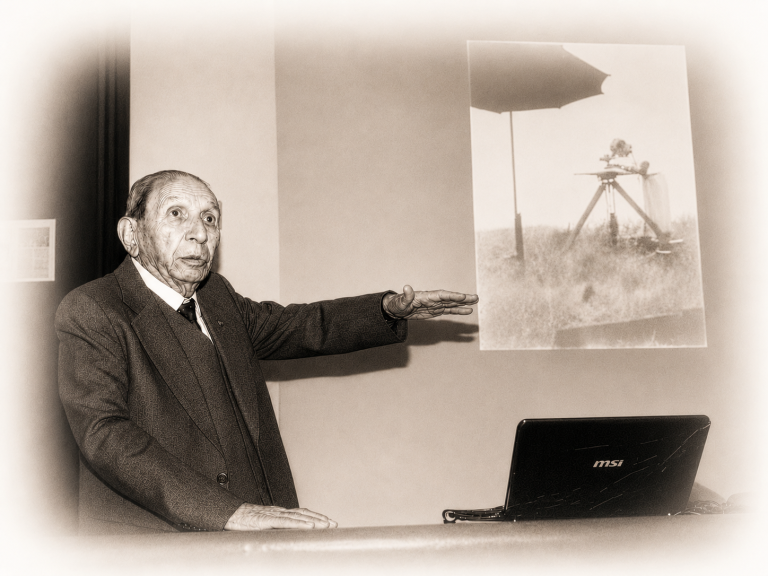
He was an Italian surveyor whose career linked field measurement, geodetic astronomy and cultural heritage conservation. Born in Rimini, he joined the Italian Military Geographic Institute in Florence in 1938, beginning a career that would lead him to become Chief Surveyor. From his first surveys in Sicily to work across deserts, mountains and archaeological sites, Pericoli combined technical precision with an exceptional capacity to adapt methods to new challenges.
His most celebrated contribution came in 1964 at Abu Simbel, where he designed an astronomically oriented reference network that helped preserve the position and orientation of the Great Temple during its relocation. His legacy is a method founded on observation, verification, responsibility and the transmission of knowledge.
Born in Rimini in 1915, Angelo Pericoli discovered surveying at technical school. In 1938 he moved to Florence to train at the Italian Military Geographic Institute.
His first field assignment took him to Sicily. He later studied geodetic astronomy and was sent to Libya to establish astronomical control points for mapping.
After coordinating survey computations in the Spanish Sahara, Pericoli joined the international effort to safeguard Abu Simbel, helping preserve the Great Temple’s original orientation and relationship with sunlight.
His expertise took him from Somalia and the Strait of Messina to Cuba and, later, to the archaeological survey of Antinoupolis in Egypt.
Pericoli combined fieldwork with research, teaching and technical writing, remaining intellectually active into his final years and leaving a legacy founded on observation, measurement, verification and responsibility.